BOOKS

(2024). Quinine’s Remains: Empires Medicine and the Life Thereafter. Oakland, CA: University of California Press.
Available in Hardcopy and Free (Open-Access) Digital Formats
What happens after colonial industries have run their course—after the factory closes and the fields go fallow? Set in the cinchona plantations of India’s Darjeeling Hills, Quinine’s Remains chronicles the history and aftermaths of quinine. Harvested from cinchona bark, quinine was malaria’s only remedy until the twentieth-century advent of synthetic drugs, and it was vital to the British Empire. Today, the cinchona plantations—and the roughly fifty thousand people who call them home—remain. Their futures, however, are unclear. The Indian government has threatened to privatize or shut down this seemingly obsolete and crumbling industry, but the plantation community, led by strident trade unions, has successfully resisted. Overgrown cinchona fields and shuttered quinine factories may appear the stuff of postcolonial and postindustrial ruination, but quinine’s remains are not dead. Rather, they have become the site of urgent efforts to redefine land and life for the twenty-first century. Quinine’s Remains offers a vivid historical and ethnographic portrait of what it means to forge life after empire.
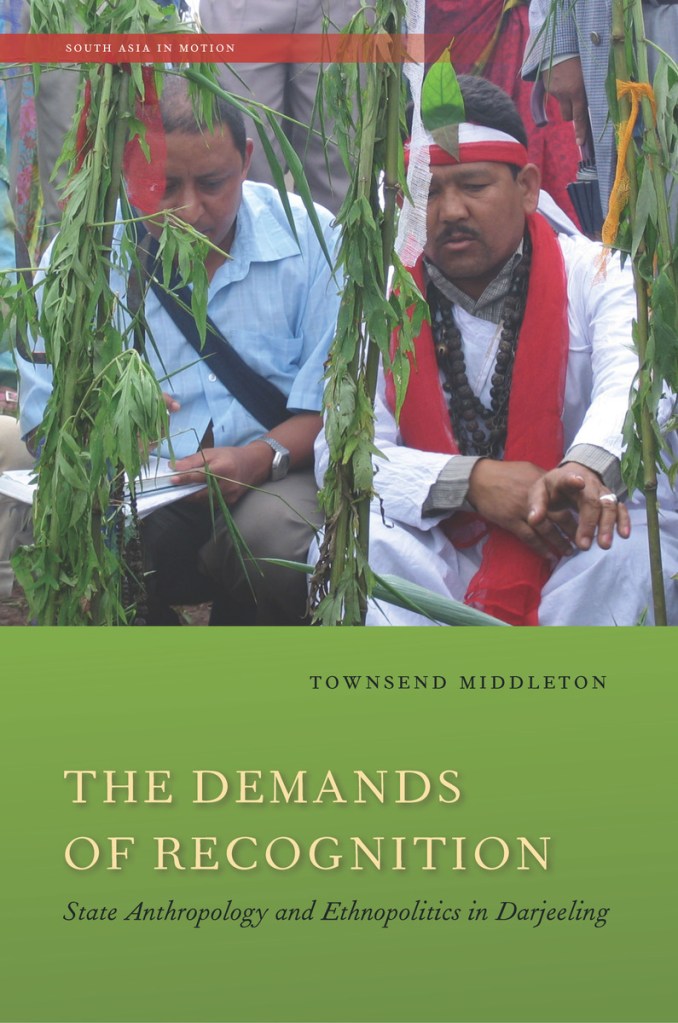
The Demands of Recognition: State Anthropology and Ethnopolitics in Darjeeling. (Stanford University Press, 2015)
Buy from Stanford University Press
Since the British colonial period anthropology has been central to policy in India. But today, while the Indian state continues to use ethnography to govern, those who were the “objects” of study are harnessing disciplinary knowledge to redefine their communities, achieve greater prosperity, and secure political rights.
In this groundbreaking study, Townsend Middleton tracks these newfound “lives” of anthropology. Offering simultaneous ethnographies of the people of Darjeeling’s quest for “tribal” status and the government anthropologists handling their claims, Middleton exposes how minorities are—and are not—recognized for affirmative action and autonomy. We encounter communities putting on elaborate spectacles of sacrifice, exorcism, bows and arrows, and blood drinking to prove their “primitiveness” and “backwardness.” Conversely, we see government anthropologists struggle for the ethnographic truth as communities increasingly turn academic paradigms back upon the state.
The Demands of Recognition offers a compelling look at the escalating politics of tribal recognition in India. At once ethnographic and historical, it chronicles how multicultural governance has motivated the people of Darjeeling to ethnologically redefine themselves—from Gorkha to tribal and back. But as these communities now know, not all forms of difference are legible in the eyes of the state. The Gorkhas’ search for recognition has only amplified these communities’ anxieties about who they are—and who they must be—if they are to attain the rights, autonomy, and belonging they desire.
 Townsend Middleton